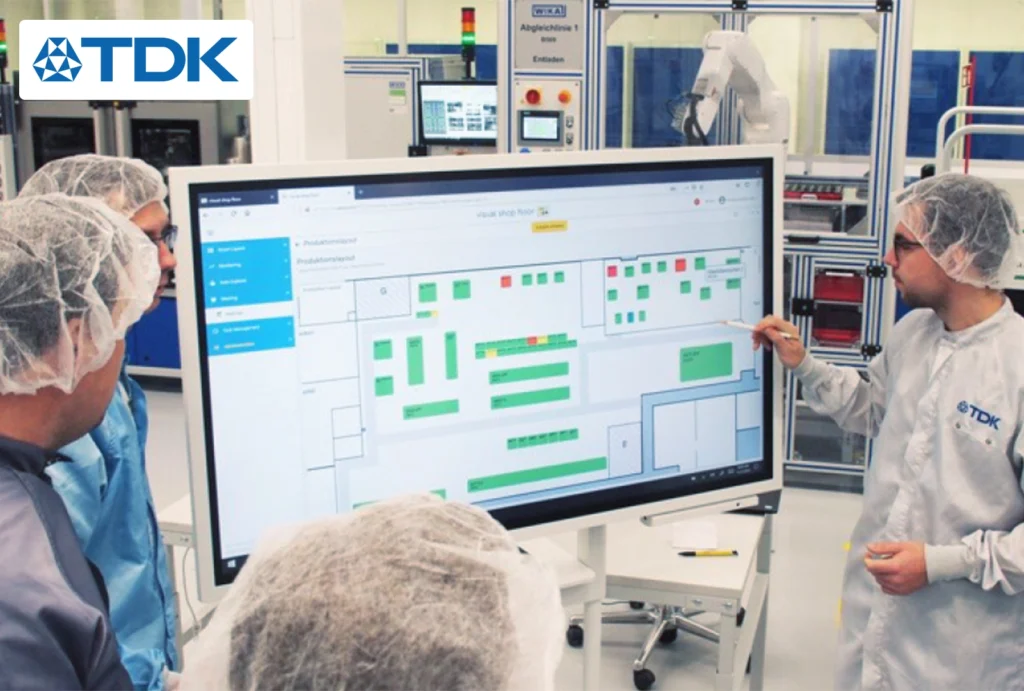

Thales Alenia Space Italia leverages Visual Shop Floor in its electronics manufacturing to digitalize short interval meetings and make daily operations lean and efficient. The solution provides real-time transparency, strengthens cross-site collaboration, and makes continuous improvement measurable in line with Lean principles. This brings true 360° digitalization of the shop floor to life – data-driven, responsive, and future-oriented.
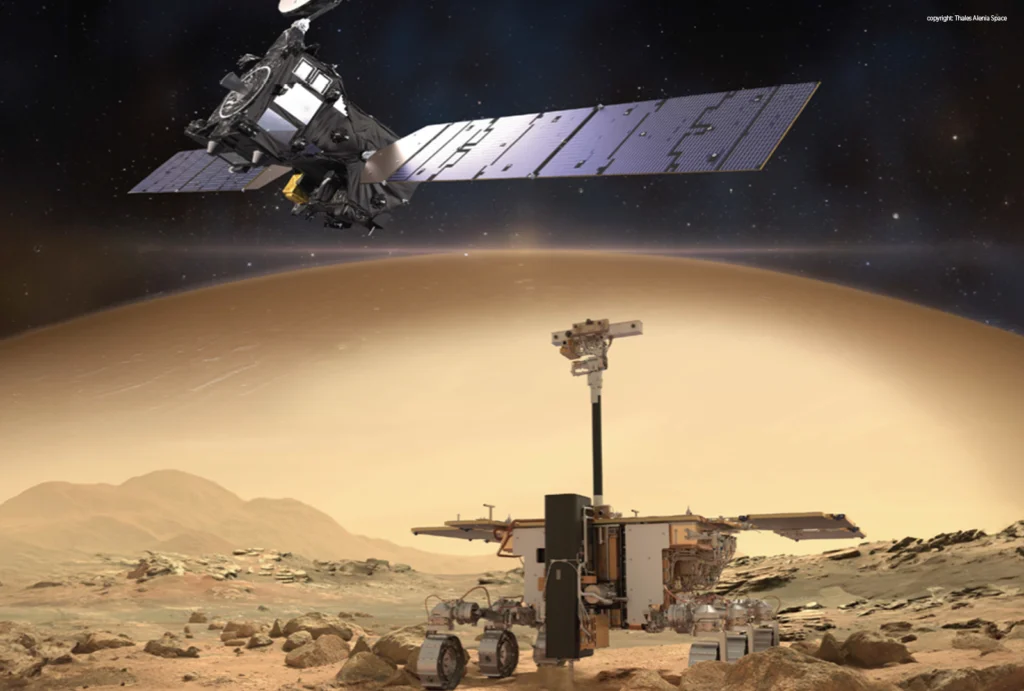
Thales Alenia Space Italia (Aerospace)

Thales Alenia Space, a joint venture between Thales (67%) and Leonardo (33%), is a global manufacturing company in the space sector that has been delivering high-tech solutions for more than forty years in telecommunications, navigation, Earth observation, environmental management, scientific research, and orbital infrastructure.
In 2025, the company reported consolidated revenues of €2.36 billion and employs more than 8,000 people across 14 sites in 7 countries in Europe.
In 2025, the company reported consolidated revenues of €2.36 billion and employs more than 8,000 people across 14 sites in 7 countries in Europe.
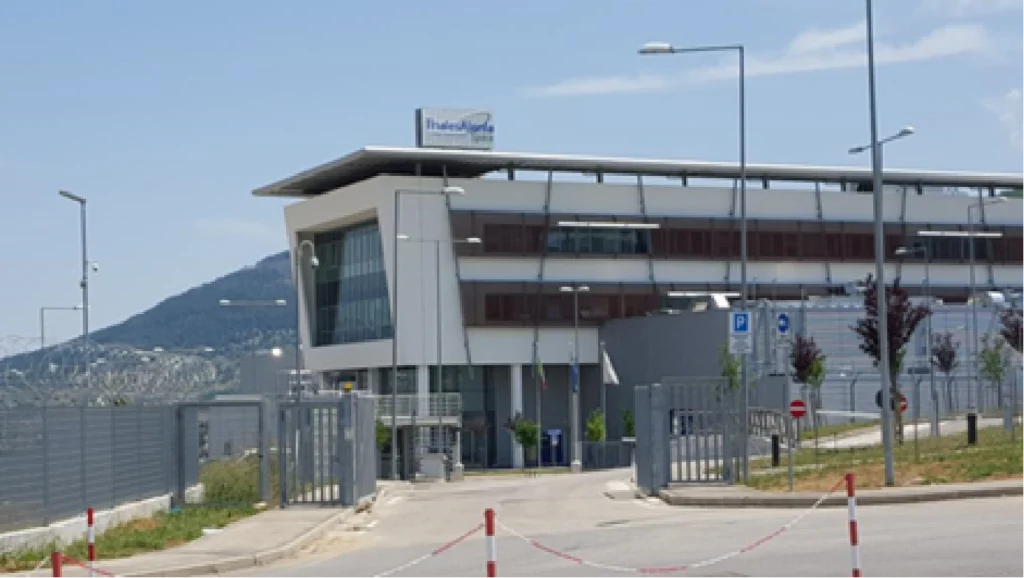
Thales Alenia Space, site at L’Aquila, Italy
Challenge
Before introducing Visual Shop Floor, Thales Alenia Space Italia faced the following challenges:
- Analog structures in shop floor management were reliable but reached their limits as demands increased – particularly in terms of scalability and rapid responsiveness.
- As production complexity grew, making fast decisions across departmental boundaries became more difficult.
- Multiple information sources led to media disruptions and delayed the implementation of critical actions.
- There was no unified digital solution to effectively support Lean methods and the Q6 framework established at Thales Alenia Space Italia.
Solution: Digital and lean with Visual Shop Floor
With the introduction of Visual Shop Floor, key processes were purposefully improved and harmonized across departments:
- Visual Shop Floor was introduced as the central platform for digitalizing daily management processes.
- Short interval meetings (SIMs) are now conducted in a structured and standardized way through visually guided workflows.
- Key KPIs such as volume, quality, and lead times can be monitored transparently in real time.
- All relevant stakeholders – from operators to management – are involved, enabling cross-functional visibility and fast coordination.
Result: Measurable success in day-to-day operations
The company-wide use of Visual Shop Floor has led to tangible improvements in daily operations:
- Lead times on the electronics lines have been significantly reduced thanks to faster responses to deviations.
- Quality has improved further, as early warnings help reduce scrap and rework.
- Daily meetings are now shorter, more efficient, and more structured.
- Transparency and data availability have increased significantly – strengthening the foundation for a strong culture of continuous improvement.
A solid analog foundation with clear growth ambitions
Before introducing Visual Shop Floor, Thales Alenia Space Italia relied on proven analog structures in shop floor management. Performance indicators, quality data, and actions were displayed directly on the production lines and discussed in daily short interval meetings (SIMs). These routines provided a reliable foundation – yet the company had set itself ambitious goals. “We wanted not only to keep our processes stable, but also to develop them further in a targeted way and make them more agile,” explains Maurizio Pietropaolo, Industrial Supply Chain IS Technician – Digital Factory Manager at Thales Alenia Space Italia.
Short Interval Meetings – the daily pace-setter in production
At Thales Alenia Space Italia, SIMs are the heartbeat of production. They create space for fast, data-driven decision-making and foster cross-functional collaboration. But as the company grew and operations became more complex, the need for digital support also increased: manual tools and fragmented information flows needed to be replaced by a unified digital solution that could provide up-to-date insights at any time. “Especially in critical moments – when time is tight and fast responses are required – a shared view of the data was essential to enable immediate action. We needed a tool that would seamlessly support our Lean methodology and our Q6 framework – and that is exactly what Visual Shop Floor delivered.”
With Visual Shop Floor, Thales Alenia Space Italia introduced a holistic digital solution that takes shop floor management to a new level. The platform provides ideal support for Lean methodology and ensures that short interval meetings are conducted efficiently, with clear structure and standardization. Among the many features of Visual Shop Floor, three core modules in particular play a key role:
Meetings: Structured, visually guided SIMs enable clear communication and faster alignment.
Task Management: Tasks are assigned transparently, tracked consistently, and completed on time.
Monitoring: Real-time KPIs are accessible to everyone at any time – across sites and remotely.
Today, the platform is used throughout all areas of electronics manufacturing at Thales Alenia Space Italia and actively involves operators, team leaders, production managers, and senior management – ensuring cross-functional connectivity and a smooth flow of information.
Tangible improvements in day-to-day practice
Since the introduction of Visual Shop Floor, the positive changes in day-to-day operations have been clearly noticeable, says Pietropaolo. Information sharing between teams is now smoother and more transparent, significantly improving cross-functional collaboration. Continuous monitoring also makes it possible to identify deviations from target values much earlier, enabling faster and more targeted implementation of countermeasures.
These developments have led to concrete improvements: lead times in specific electronics lines have been significantly reduced. Early quality warnings have also helped cut scrap considerably – resulting in a measurable increase in overall quality. The efficiency of the daily short interval meetings (SIMs) has improved noticeably as well: their structured preparation and execution save valuable time and encourage more focused discussions. At the same time, performance monitoring has become far more precise and effective thanks to the increased speed in implementing corrective actions.
With Visual Shop Floor, we have achieved 360° digitalization of our electronics manufacturing – lean-oriented, transparent, and highly responsive.”
Maurizio Pietropaolo,
Industrial Supply Chain IS Technician - Digital Factory Manager, Thales Alenia Space Italia
More than just a software system: A driver of modern and sustainable manufacturing culture
According to Pietropaolo, the greatest added value of Visual Shop Floor lies in its seamless combination of visibility, operational control, and structured task management within a single platform. This fosters a data-driven culture of continuous improvement, strengthens collaboration, and enables sustainable gains in efficiency. “At the same time, the modern solution reinforces Thales Alenia Space Italia’s image as an innovative, transparent, and future-oriented manufacturing organization,” Pietropaolo concludes.
Expansion and future outlook: On the path to a group-wide solution
Following the successful implementation of Visual Shop Floor at Thales Alenia Space’s site in L’Aquila, Italy, the next steps are now taking shape: the platform will be used for additional use cases at the L’Aquila site and, in the future, rolled out to further plants in Italy and across Europe. The goal is to standardize visual management across all production sites, enabling even greater transparency and control throughout the entire group.
“Among the key factors behind our decision were the flexibility of the licensing model, which fits well with our organizational structure, the option of an on-premise installation to meet security and integration requirements, and the high level of user-friendliness and compatibility with existing processes, which significantly facilitated the implementation,” Pietropaolo explains. The corporate headquarters has also shown strong interest in evaluating and rolling out the software.
As a result, Visual Shop Floor will increasingly serve not only as a central tool for supporting short interval meetings, but also as a key enabler of a data-driven culture of continuous improvement across the entire group.
5 success factors: What to focus on when implementing Visual Shop Floor:
Tips from Maurizio Pietropaolo,
Industrial Supply Chain IS Technician – Digital Factory Manager bei Thales Alenia Space Italia
01.
Clear governance & stakeholder involvementAll relevant divisions – production, IT, quality, and security – should be involved from the outset and integrated into a shared rollout plan.
02.
Integrate data sourcesStructured and continuously updated data are essential to unlocking the full potential of Visual Shop Floor. Static Excel files significantly limit this potential – an avoidable risk.
03.
Provide the IT infrastructureExisting policies on network, security, and user management must be understood and adhered to during the implementation of Visual Shop Floor.
04.
Pilot phase with a Proof of ConceptA PoC in a clearly defined area helps minimize risks and makes the concrete added value visible at an early stage.
05.
Change management & trainingTechnology alone is not enough – the transformation succeeds only with targeted training and the active involvement of employees.