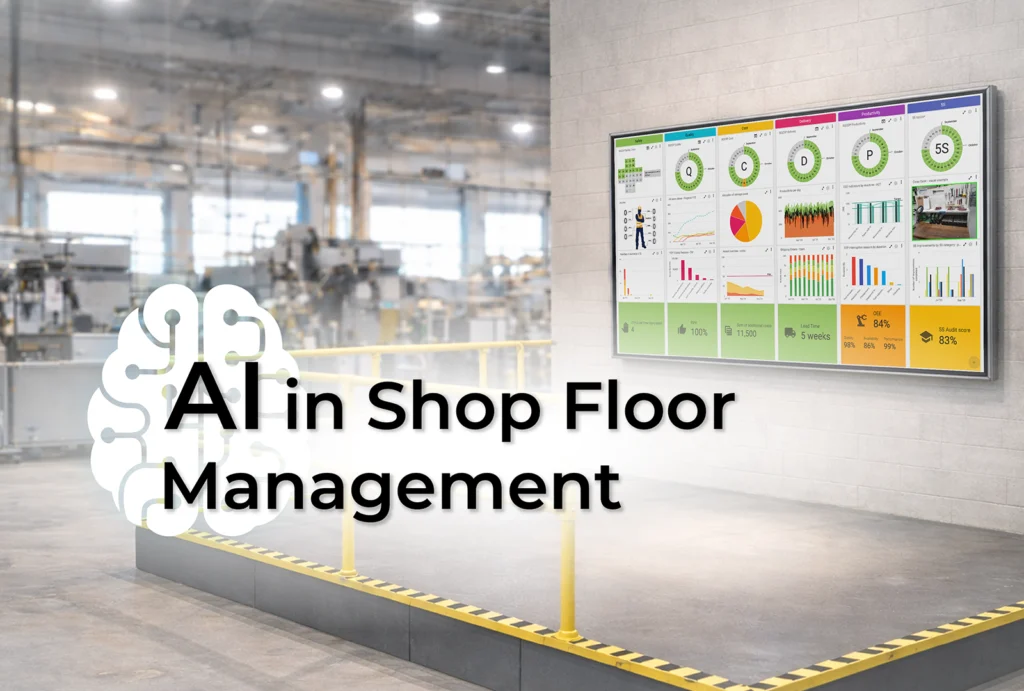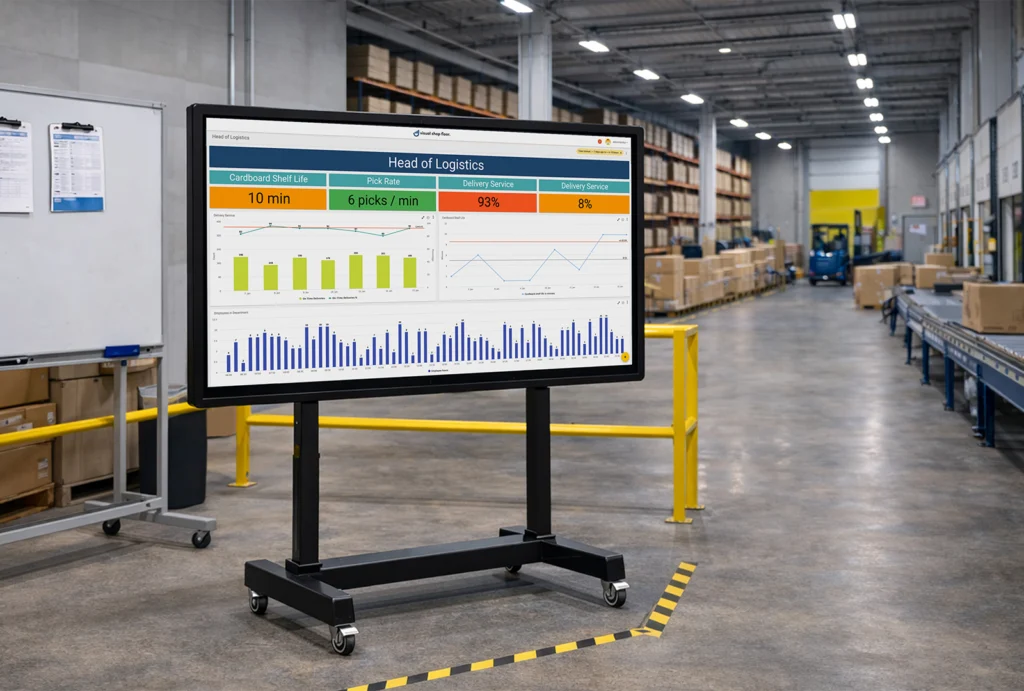


Shop Floor Board for efficient and structured communication at the point of value creation.
In many manufacturing organizations, Shop Floor Boards have become a standard component of Shop Floor Management. They display production KPIs, quality metrics, disruptions, and improvement actions, visualize processes, and provide a central source of operational information. Their purpose is to increase transparency, identify issues early, and support continuous improvement.
In practice, however, the reality often looks quite different. Even with digital Shop Floor Boards in place, response times remain slow, deviations are identified too late, and improvement actions are not consistently executed.
The underlying issue is often not a lack of transparency, but rather the assumption that transparency alone equals operational control. A Shop Floor Board does not create effective operational management by itself. Especially in dynamic manufacturing and logistics environments, simply displaying KPIs – even in digital form – is no longer sufficient. What matters is that information is accurate, up to date, and presented in the right operational context. It must be embedded into structured communication and decision-making processes and translated into concrete actions that are consistently tracked to completion.
In practice, however, the reality often looks quite different. Even with digital Shop Floor Boards in place, response times remain slow, deviations are identified too late, and improvement actions are not consistently executed.
The underlying issue is often not a lack of transparency, but rather the assumption that transparency alone equals operational control. A Shop Floor Board does not create effective operational management by itself. Especially in dynamic manufacturing and logistics environments, simply displaying KPIs – even in digital form – is no longer sufficient. What matters is that information is accurate, up to date, and presented in the right operational context. It must be embedded into structured communication and decision-making processes and translated into concrete actions that are consistently tracked to completion.
Why many Shop Floor Boards lose their impact
In many organizations, Shop Floor Boards fail not because of technology, but because they are not effectively integrated into day-to-day operations. Typical challenges include unclear objectives, an overload of KPIs, outdated information, manual maintenance efforts, poor action tracking, and limited user adoption. Another common issue is that Shop Floor Boards are often treated as static systems. Manufacturing processes, however, are constantly evolving – and so are the requirements for information, communication, and operational management.
Successful organizations therefore adopt a continuous improvement approach to their Shop Floor Boards. Content, structures, and workflows are regularly reviewed and adapted to changing business needs. At the same time, employees are actively involved to ensure usability, increase acceptance, and align the system with the practical requirements of its users.
Ultimately, successful Shop Floor Management is not driven by technology alone. It depends on a leadership culture that actively promotes transparency, accountability, and continuous improvement across the organization.
Successful organizations therefore adopt a continuous improvement approach to their Shop Floor Boards. Content, structures, and workflows are regularly reviewed and adapted to changing business needs. At the same time, employees are actively involved to ensure usability, increase acceptance, and align the system with the practical requirements of its users.
Ultimately, successful Shop Floor Management is not driven by technology alone. It depends on a leadership culture that actively promotes transparency, accountability, and continuous improvement across the organization.
Shop Floor Management is more than KPI visualization
The original concept of Shop Floor Management was never centered around dashboards or reporting systems. Instead, it is based on operational leadership at the point of value creation. Its purpose is to identify deviations early, address problems systematically, and implement sustainable improvements.
This is exactly where many traditional – and even digital – Shop Floor Boards reach their limits. Organizations often end up with an abundance of information but little operational impact. KPIs are displayed but not consistently used. Improvement actions are defined but not systematically followed through. Meetings take place, yet they do not always result in clear commitments or effective decisions.
Increasingly, organizations recognize that the true value of modern Shop Floor Boards lies not in visualization itself, but in enabling structured communication, operational leadership, and action management.
This is exactly where many traditional – and even digital – Shop Floor Boards reach their limits. Organizations often end up with an abundance of information but little operational impact. KPIs are displayed but not consistently used. Improvement actions are defined but not systematically followed through. Meetings take place, yet they do not always result in clear commitments or effective decisions.
Increasingly, organizations recognize that the true value of modern Shop Floor Boards lies not in visualization itself, but in enabling structured communication, operational leadership, and action management.
Transparency only creates value when it leads to action
Transparency remains the foundation of effective Shop Floor Management. What truly matters, however, is which information is provided, how it is contextualized, and how it drives structured decision-making and concrete actions.
Today, many organizations do not suffer from a lack of data. Instead, they struggle with inconsistent, fragmented, and non-actionable information. Disconnected systems, outdated data, and manual data collection often result in KPIs that reflect isolated metrics rather than the actual situation on the shop floor. For operational management, this creates significant risks. Problems are identified too late, decisions are delayed, and corrective actions lose effectiveness.
Modern Shop Floor Boards therefore need to deliver far more than KPI visualization. They must continuously update information, present it in a clear and understandable way, and place it into the appropriate operational context. Only then can teams develop a shared understanding of current conditions, priorities, and required actions – the essential basis for effective operational decision-making.
Equally important is maintaining the right balance between information availability and clarity. Effective Shop Floor Boards do not display as much information as possible. Instead, they provide exactly the information that is relevant for a specific role, situation, or decision. Focus always outweighs information overload.
Today, many organizations do not suffer from a lack of data. Instead, they struggle with inconsistent, fragmented, and non-actionable information. Disconnected systems, outdated data, and manual data collection often result in KPIs that reflect isolated metrics rather than the actual situation on the shop floor. For operational management, this creates significant risks. Problems are identified too late, decisions are delayed, and corrective actions lose effectiveness.
Modern Shop Floor Boards therefore need to deliver far more than KPI visualization. They must continuously update information, present it in a clear and understandable way, and place it into the appropriate operational context. Only then can teams develop a shared understanding of current conditions, priorities, and required actions – the essential basis for effective operational decision-making.
Equally important is maintaining the right balance between information availability and clarity. Effective Shop Floor Boards do not display as much information as possible. Instead, they provide exactly the information that is relevant for a specific role, situation, or decision. Focus always outweighs information overload.
Operational leadership requires structured communication
One of the biggest weaknesses of many Shop Floor Management initiatives is not technology, but the lack of accountability within routine communication processes.
Daily Shop Floor meetings play a critical role. This is where deviations are reviewed, root causes are analyzed, decisions are made, and actions are assigned. Without a structured framework, however, these meetings quickly lose their effectiveness. Discussions drift into minor details, valuable information remains unused, responsibilities become unclear, and agreed actions are not consistently followed up in day-to-day operations.
Effective Shop Floor Management therefore requires more than reliable operational data. It also depends on standardized communication and leadership processes, including clear meeting agendas, defined escalation paths, assigned responsibilities, transparent action management, and consistent follow-up. Only then can organizations establish the level of accountability required to embed continuous improvement into everyday operations.
Modern digital Shop Floor Boards support exactly this process. They are not merely information displays, but central platforms for operational management. KPIs provide the factual foundation for structured meetings, actions are documented immediately, and progress is tracked transparently.
This becomes particularly important in larger organizations, where the Shop Floor Management cascade – the structured communication and escalation of information across multiple management levels – plays a vital role. Information, decisions, and actions must be communicated consistently throughout the organization. Only when issues are escalated systematically and responsibilities are clearly assigned can organizations sustainably reduce response times.
Daily Shop Floor meetings play a critical role. This is where deviations are reviewed, root causes are analyzed, decisions are made, and actions are assigned. Without a structured framework, however, these meetings quickly lose their effectiveness. Discussions drift into minor details, valuable information remains unused, responsibilities become unclear, and agreed actions are not consistently followed up in day-to-day operations.
Effective Shop Floor Management therefore requires more than reliable operational data. It also depends on standardized communication and leadership processes, including clear meeting agendas, defined escalation paths, assigned responsibilities, transparent action management, and consistent follow-up. Only then can organizations establish the level of accountability required to embed continuous improvement into everyday operations.
Modern digital Shop Floor Boards support exactly this process. They are not merely information displays, but central platforms for operational management. KPIs provide the factual foundation for structured meetings, actions are documented immediately, and progress is tracked transparently.
This becomes particularly important in larger organizations, where the Shop Floor Management cascade – the structured communication and escalation of information across multiple management levels – plays a vital role. Information, decisions, and actions must be communicated consistently throughout the organization. Only when issues are escalated systematically and responsibilities are clearly assigned can organizations sustainably reduce response times.
Standardization as the foundation of effective operational management
One of the most underestimated success factors in Shop Floor Management is standardization. Without standardized KPIs, meeting structures, and operational processes, organizations quickly develop inconsistent management practices. Different departments work with different definitions, information is interpreted inconsistently, decisions lose alignment, and corporate objectives become more difficult to achieve.
Modern Shop Floor Boards must therefore strike the right balance between standardization and flexibility. They should support organization-wide leadership and communication standards while allowing sufficient flexibility to accommodate different departments, roles, and operational requirements.
This highlights a fundamental difference between traditional dashboard solutions and true Shop Floor Management platforms. While dashboards primarily visualize information, dedicated Shop Floor Management solutions support standardized workflows, structured communication, and systematic action tracking. As a result, they become far more than information displays – they become active tools for operational execution.
Modern Shop Floor Boards must therefore strike the right balance between standardization and flexibility. They should support organization-wide leadership and communication standards while allowing sufficient flexibility to accommodate different departments, roles, and operational requirements.
This highlights a fundamental difference between traditional dashboard solutions and true Shop Floor Management platforms. While dashboards primarily visualize information, dedicated Shop Floor Management solutions support standardized workflows, structured communication, and systematic action tracking. As a result, they become far more than information displays – they become active tools for operational execution.
Conclusion
Shop Floor Boards have evolved significantly over recent years. Today, their true value extends far beyond KPI visualization. They have become essential tools for supporting operational leadership, structured communication, and accountable action management.
Transparency remains the foundation. However, it only delivers value when information is current, consistent, and actionable – and when it leads directly to informed decisions and measurable improvements.
Organizations that view Shop Floor Management as an integrated leadership and continuous improvement system create the conditions for faster response times, greater process stability, and sustainable operational excellence.
Transparency remains the foundation. However, it only delivers value when information is current, consistent, and actionable – and when it leads directly to informed decisions and measurable improvements.
Organizations that view Shop Floor Management as an integrated leadership and continuous improvement system create the conditions for faster response times, greater process stability, and sustainable operational excellence.